What to Expect in the Autumn Budget 2025
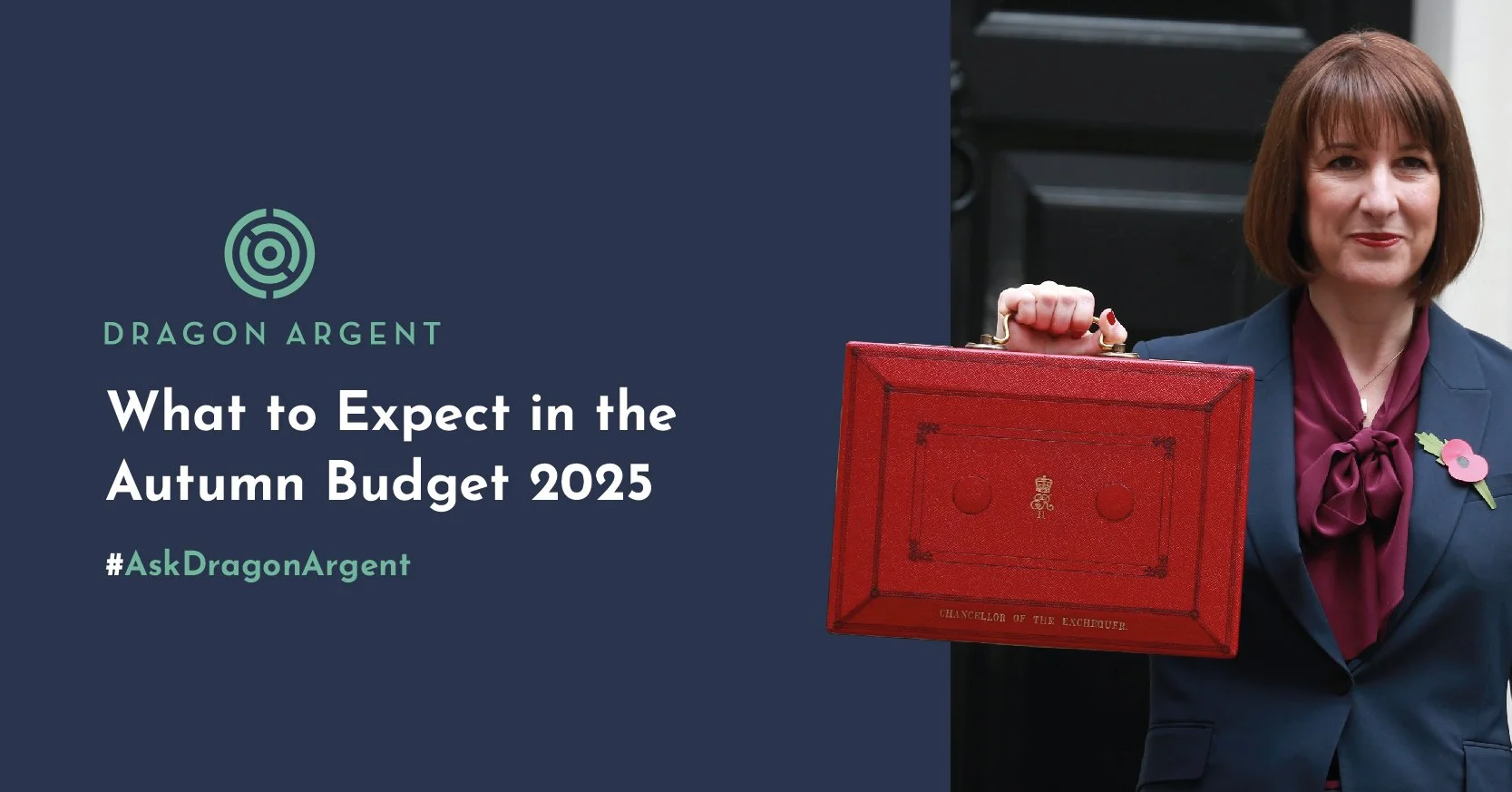
On Wednesday 26 November 2025, Rachel Reeves will deliver the Autumn Budget. Given the backdrop of weak productivity, high debt and constrained growth, the scope for tax rises and relief-changes is rising. For business owners, founders, family-businesses and high-net-worth individuals, understanding the likely measures—and acting ahead of year-end—is critical. Below is an analysis of the key areas where change is likely, and how you should be thinking about them now.
The fiscal context
The UK’s fiscal position is tight: the Office for Budget Responsibility (OBR) is reportedly planning to downgrade productivity growth by ~0.3 points — equivalent to a fiscal hit of more than £20 billion over the medium-term.
Government borrowing remains elevated and debt as a share of GDP is high, meaning the Chancellor faces heavy pressure to fill a “budget hole”.
The Labour Party manifesto had pledged not to raise income tax, VAT or national insurance for “working people” or “core rates”.
However, given the limited headroom, attention is turning to less conspicuous tax levers, reliefs and wealth-tax changes rather than headline core rate hikes.
In short: for you as business owners or high-net-worth individuals, the expectation should be targeted reform and relief-changes, rather than dramatic headline rate increases, but many of those reforms could bite across investment, property, inheritance, capital gains and pensions.
Key rumoured measures & their implications
Here are the main rumours circulating, with commentary on what they would mean for business owners / family businesses / HNWIs.
1. Freezing (or reducing) thresholds and allowances
One of the more politically palatable “stealth” tax options is to freeze income tax, capital gains tax (CGT) and inheritance tax (IHT) thresholds for longer, thereby pulling more taxpayers into higher bands without increasing the headline rates.
Freezing income tax thresholds is widely flagged as a likely lever, raising billions over time.
CGT / IHT reliefs may also be trimmed or allowances frozen.
Implications for you
If you’re a business owner drawing salary/bonus, a frozen personal allowance or higher-rate threshold could increase your tax bill sooner than expected.
For family businesses, inherited shareholdings or transfers may face increased IHT liability if thresholds remain static while asset values rise.
Planning ahead: consider whether certain income or gains can be crystallised before threshold freezes bite, or whether reliefs can be locked-in now.
2. Wealth and property taxes – new or expanded
There is growing speculation that the Chancellor will explore the “optics” of increasing taxes on wealth, high-value property and investment returns (rather than broad-based tax rises).
Rumours include a “mansion tax” or higher rates/leverage on very high-value homes.
Changes to IHT and reliefs for business or agricultural estates are also under scrutiny.
Implications for you
If you hold significant real-estate assets (especially through a business structure or family trust), any additional levy or tax change could significantly impact your balance sheet.
Family business owners need to pay particular attention to inter-generational transfer reliefs: if reliefs are reduced, what looked like a safe transfer may become far more expensive.
Strategic move: review your property ownership structures, trust/holding arrangements, and evaluate whether sooner action could reduce potential tax exposure.
3. Pension tax relief, tax-free cash and retirement planning changes
Pension tax relief remains a recurring target for revenue-raising and has surfaced in speculation for this Budget.
Rumours include further restrictions on the tax-free cash lump sum and possible tapering of higher-rate relief for high earners.
Changes could impact business owners who benefit from generous pension contributions, or those planning significant pension crystallisation.
Implications for you
If you are planning large pension contributions this tax year, review whether you need to accelerate this ahead of any change.
If you intend to draw tax-free cash or restructure pension benefits, you may want to act before reforms are announced.
For family business owners considering shareholder pensions or executive retirement planning, this is an area to get advice now.
4. Corporation tax, reliefs and business investment incentives
While the core rate of corporation tax may be off-limits (given manifesto commitments and investment-agenda signalling), reliefs and investment incentives are likely lines of change. According to commentary:
The government may look to curtail some tax reliefs (e.g., R&D, capital allowances) or redefine eligibility to raise revenue.
Incentives to encourage investment (especially green/sustainable) may be retained or enhanced, but funded by closing reliefs elsewhere.
Implications for you
Business owners: review whether you are claiming all relevant reliefs now (R&D, capital allowances, investment zones) and whether structuring changes before end-of-tax-year can help.
Consider whether planned large-scale investment can be accelerated into current tax year to secure reliefs before any tightening.
Review shareholders’ salaries/dividends mix in light of potential relief changes.
5. Capital Gains Tax (CGT) and Exit/Shareholder Planning
CGT is widely cited as a key target given rising asset values and the need to raise revenue without increasing headline rates.
Possible changes: lower reliefs, higher effective rate for “wealthy” disposals, or restriction of Entrepreneurs’ Relief/Business Asset Disposal Relief.
This is especially relevant for founders looking to exit, or family business owners planning inter-generational transfers.
Implications for you
If you are planning a sale/partial sale of your business, consider whether accelerating it into the current tax year makes sense.
If you are transferring shares to your children/spouse or re-structuring ownership, check the timing and tax reliefs currently available.
Review existing trusts and holding companies: what reliefs are built in and how might they be exposed by change?
6. Year-end strategic window
Because the Budget takes effect from the date of announcement or the next tax year, the period between now and the end of the tax year presents a planning window.
What to think about now:
Lock in reliefs and allowances (e.g., pensions, capital allowances, R&D credits) before announcement risk.
Review your income timing: for example, deferring a dividend until after reform vs accelerating it now may make a material difference.
For family businesses: review succession plans and asset transfers — once reliefs are amended, the impact could be long-lasting.
Keep in mind that rumours may not translate into policy exactly as expected — so avoid making radical strategic decisions without professional tax advice.
For business owners, family firms and High Net Worth Individuals:
Given the rumoured landscape, here are three key strategic priorities:
Pre-budget review: Before 26 November, run a tax exposure check. For example:
Are you utilising available reliefs now (pension, R&D, capital allowances)?
Are any employee/shareholder transactions planned that may be affected by emerging tax rules?
Are asset/property/asset transfers to next generation optimized under current rules?
End-of-tax-year timing: Use the window between now and tax-year end to crystallise opportunities where advisable but balanced with commercial and personal planning goals.
Post-Budget responsiveness: Once the Budget is published, update your plans quickly. What may have seemed unlikely before (e.g., IHT relief cuts or CGT changes) may become real and the cost of delay can be high.
The Autumn Budget 2025 poses significant challenges, but also opportunities for business owners, family firms and high-net-worth individuals. While the Chancellor is constrained politically, the pressure on the public finances means that targeted tax reforms (rather than headline tax rate hikes) are the most likely route. That means your planning matters now: the sooner you are prepared, the better positioned you will be to respond.
If you’d like expert guidance on how the Autumn Budget measures could impact you or your business, we invite you to:
Book a call with our Accounts & Tax team to discuss tailored planning strategies ahead of the Budget.
Register for our upcoming live webinar on Friday 28 November 2025 at 11:00 am, where our Tax & Accounts specialists will break down the announcements and share practical steps.
👉 Secure your place now
Don’t leave your tax planning to chance, let’s get ahead of the changes together.
Speak to one of our Tax Advisers today ↓
Join our network of entrepreneurs and benefit from a range of support including an ecosystem of trusted partners, our weekly blog, plus webinars and whitepapers on the leading challenges founders face when scaling businesses.