The Oatly Judgment: No Use Crying Over Oat Milk
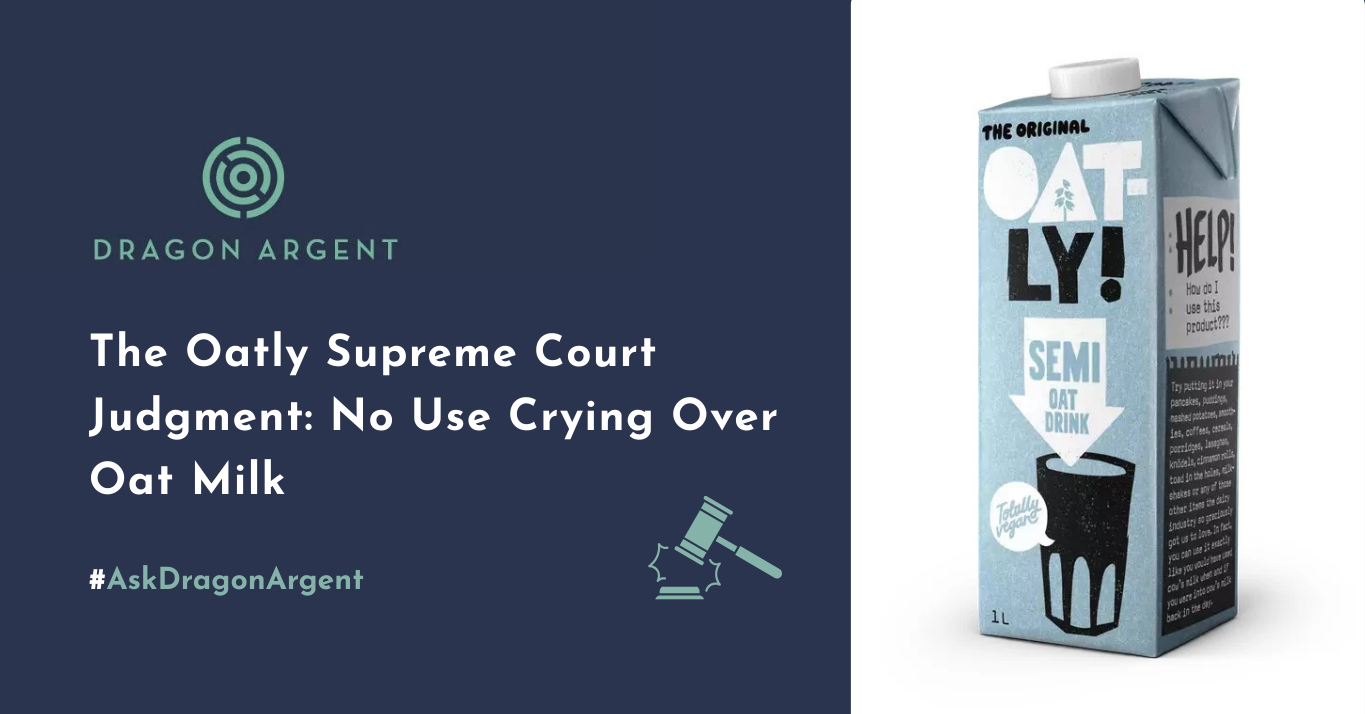
In its Judgment given on 11 February 2026, the UK Supreme Court confirmed that, for Point 5 of Annex VII, Part III to Regulation (EU) No 1308/2013, ‘designation’ is not confined to a product’s name, and that the ‘characteristic quality’ limb of the proviso is applied strictly. The decision resolves those points in a trade mark invalidity challenge concerning oat-based food and drink, but it does not answer every borderline question, including the post-Brexit mechanics for updating the ‘traditional usage’ list.
The Verdict in Brief: A Strict Interpretation
What does “designation” mean?
Oatly argued that “designation” means the formal product name, so a slogan should fall outside the restriction. The Supreme Court rejected this, holding that "designation" extends to any use of a protected term in respect of a food or drink, irrespective of , whether as a name, slogan, or brand mark.
Does the “characteristic quality” exception apply?
The legislation contains a proviso allowing protected terms where they are “clearly used to describe a characteristic quality of the product.” Oatly argued its mark communicated that the products are milk-free. The Court disagreed, finding that “POST MILK GENERATION” primarily describes the target consumer, not a quality of the product itself. Any reference to product qualities was too oblique to meet the high threshold of “clearly used.”
In effect, the Court applied the exception so strictly that it effectively closed the door on Oatly's argument. Protected dairy terms used in trade marks for non-dairy food and drink will generally be prohibited, and the descriptive quality exception will be interpreted narrowly, requiring a very clear and direct link between the wording and the product characteristic.
Why This Ruling Matters for Your Business
The operative rule is not a trade mark rule. This case clarifies that the UK courts will rigorously enforce retained EU regulations designed to protect dairy terminology.[1] For your business, this could create some intangible risks.
1. Existing Trade Marks Could Be at Risk
If your brand portfolio includes any registered marks that feature a protected dairy term for non-dairy goods, those registrations are now vulnerable to challenge. As this case proves, even a well-known brand with significant market presence can have its IP rights invalidated by a competitor or trade association. The cost of defending such a challenge – or worse, losing a brand you've invested heavily in – can be substantial.
2. Marketing and Product Descriptions Are Under Scrutiny
The restriction is not limited to trade marks. It extends to all commercial communication, including product labels, packaging, advertising, and online descriptions. Using terms like “oat milk,” “vegan cheese,” or “yoghurt alternative” in a way that could be seen to imply a dairy food or drink connection may now be risky.
A simple descriptor could become the basis for a complaint to regulators or an opposition proceeding.
3. The Regulatory Environment Has Hardened
The Supreme Court has confirmed that “designation” means any use of a protected term, not just the formal product name. This broad interpretation means that creative, slogan-based branding (like Oatly's) is not a safe harbour. Furthermore, the exception for describing a “characteristic quality” will be interpreted exceptionally narrowly.
In this case, the Court found that “post milk generation” described the consumer, not a quality of the product. This signals a zero-tolerance approach to clever wordplay that skirts the rules.
Wider Consideration for Emerging Products
This Supreme Court decision underscores a key challenge for businesses developing product alternatives: balancing innovative marketing with strict legal boundaries on protected terms. Businesses may wish to consider safer terminology for their branding which focuses on the dairy free food and drink product rather than reference to diary terms.
More widely, this decision serves as a useful reminder that businesses launching newer products, particularly in regulated sectors, must remain vigilant about applicable rules, which can unexpectedly invalidate plans or prohibit use entirely. Here, the ruling went beyond denying trade mark registration, requiring cessation of actual use as well.
How Dragon Argent can help
For plant-based and alternative protein brands, this judgment represents a structural tightening of the regulatory environment. It reduces the scope for creative interpretation and strengthens the position of trade bodies and competitors seeking to challenge registrations or marketing practices. Businesses that treat this as a narrow trade mark issue risk underestimating its wider commercial consequences. Where brand equity is central to enterprise value, regulatory vulnerability is a material risk.
Dragon Argent advises growth-stage and international food and beverage businesses at the intersection of intellectual property, regulation and expansion. We undertake detailed portfolio reviews, assess packaging and digital communications for exposure, and develop resilient brand strategies capable of withstanding scrutiny in the United Kingdom and the European Union. Where risk is identified, we design compliant and commercially effective alternatives. If your brand incorporates protected dairy terminology in any form, now is the appropriate time to review its position.
[1] Annex VII of Regulation (EU) No 1308/2013, which was retained in UK law after Brexit, provides definitions, designations, and sales descriptions apply to specified sectors, including milk and milk products, and may be used “only for the marketing” of compliant products. For example, “Milk” is defined as “exclusively the normal mammary secretion obtained from one or more milkings”.
Speak to one of our litigation solicitors today ↓
Written by:

Head of Litigation, IP & Art Law

Litigation Solicitor
Join our network of entrepreneurs and benefit from a range of support including an ecosystem of trusted partners, our weekly blog, plus webinars and whitepapers on the leading challenges founders face when scaling businesses.